18 Jan 2011

28 Nov 2010
Apu's Homecoming: Short Story

10 Nov 2010
An Award and some Revelations
 The lovely and humorous Gargi hononoured me with the Honest Scrap Award sometime back. As the recipient, I must tell you all ten things about myself.
 Disclaimer: The author shall not be deemed responsible for any boredom this post may cause.
1) The first prize I ever won was for a recitation competition. I was in class (grade) I and bagged a consolation prize for reciting a poem by Swami Vivekananda.
2) In class VI when I had to give up one of the two extracurricular activities of dance and music, I let go of dance. Music has stayed with me, ever since.
3) It was in class VI only that any recognition of my writing came about. The perpetrator of this act was an essay I wrote about a trip to Appu Ghar, an amusement park in Delhi. Our English teacher, with whom I am still in touch, wrote "Good" at the end of it.
4) As a Bengali, I am crazy about fish--possibly in any and all forms. Unlike many Bengalis, I am not so crazy about sweets. There, I said it.
5) I wrote my first short story at age 14. It was in Bangla and was lucky enough to meet the approval of my immensely talented (and accomplished) author Grandma.
6) A place I return to (and must keep returning to) again and again is Santiniketan. I wasn't born or raised there, but it's a heart's connection I haven't been able to explain or eliminate.
7) The first trip I ever made outside my hometown was to the historic city of Agra. Fatehpur Sikri enchanted me even more than the world wonder, Taj Mahal.
8) My technologically challenged brain causes me eternal frustration...Sigh.
9) My first foreign trip happened in 2009, courtesy a translation Fellowship I won for my translation of a remarkable book on legendary sculptor-painter, Ramkinkar Baij. I was in the lovely city of Norwich, UK, for two months.
10) I met my husband through this very blog. He is even there on my blogroll. :)
6 Oct 2010
Night Light
Comes the news of your arrival.
As I dive into the sea of slumber
You wake up,
Fusing the conscious with the unconscious.
The night goes silent, draping a blanket of darkness.
You radiate
In your own light, intrinsic glory--
A star.
At dawn, I wake up,
My feet touch the ground
There too, I see you—
In soft, full smile.
Footloose, the night’s star and the earth’s dust
Embrace, sway each other.
I bow down, pick you up,
To give meaning to my worship.
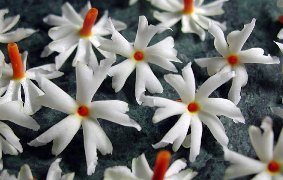
Note: Every autumn, as Durga Puja, the biggest festival of Bengalis, approaches, a certain delicate flower blooms quietly in the night, spreading its soft fragrance all over. Since my childhood, this tropical bloom has awed me with its magical essence. In Bengali, we call the flower Shiuli or Shefali.
Disclaimer: I am not a poet and don't claim this is poetry. It's just a spontaneous expression, triggered by memory.
22 Sept 2010
Framed Notes from Beyond
 Postcards from Ladakh
Kunzum
Non-fic (Travel)
Price: INR 395, US $19.95, UK £11.95
Available at: Ajay Jain's Blog
Among the souvenirs I collect during my travels, picture postcards are recurring visitors. Besides being light in weight--both in terms of mass and price, these cards open mini windows to new worlds. Easy to carry, easy to share, easy to keep or frame--picture postcards have almost everything going for them. Well, almost. My one pet peeve with these cards has been the limited information one usually gets about the picture in question--mostly just a line or two and at the most, about a paragraph. Ajay Jain's new book, Postcards from Ladakh, redresses this issue with commendable facility.
With this book, Jain takes us inside the astonishingly beautiful yet often difficult terrain of Ladakh--among the remotest and most sparsely populated regions of India. Every page you turn is a new postcard--the picture on the left and Jain's notes on the right. As he notes in one of the opening chapters titled Ladakh, Circa 2009, "Start reading from any page," for you won't miss anything if you didn't follow the exact order of the postcards.
The pictures grab the reader's attention right away, and once I had seen/read a few cards, I started imagining my own reading of the images before my eyes floated over to Jain's text. Since this world was as alien to me as that of tribes living in the Congo basin, my imagination couldn't stretch too far. That's where this book succeeded in style. It presented me with just enough information on each accompanying picture without overwhelming me with a flood of it or depriving me by sharing too little. Jain writes the notes in affable first and second person voices, generously interspersing them with wit, practical advice and most of all, his passion for the place.
A big chunk of the postcards reflect Ladakh's Buddhist tradition, its intricacies, distinguishing features and sovereign influence on the local populace. Others highlight the region's flora, fauna, economy, history, and geology. The last few chapters are extremely useful for anyone planning a trip to Ladakh. In these, Jain provides an experienced traveller's tips on how to pack, how to move about and how to keep the environment clean. There's also an engaging interview with Ladakh's spiritual supremo, the Twelfth Gyalwang Drukpa. I found this a nice touch to this collection of postcards.
I leave you now with an invitation to read this book and with some of my favourite postcards:
This image, depicting an old apricot collector, arrested my attention for quite a while. Do you also find the wrinkles on his face speaking of an unknown, unknowable pain?
 Rock art dating to the 6th century AD. On a single rock in the entire region. Intrigued to know more? Visit Ladakh to find out. Or just read Postcards from Ladakh.
Stories like the one this postcard tells warmed my heart the most. It shows a bunch of happy little children who shared their bounty of sweet peas with the author, expecting nothing in return. Although he did reward them with chocolates, I suspect, he was the bigger winner.

This all-religion shrine, situated in the harsh Siachen glacier is believed to bless its devotees, mostly military soldiers, with special "visions."

And lastly, this multi-image postcard about Himalayan marmots is just too good to be denied a mention. The author was lucky himself and shares his most entertaining encounter with these "adorable creatures," who are often a little shy of human presence.

The only additional feature I wished the book included is a glossary of terms. Some of the Ladakhi Buddhist references can get confusing, even with repeated reading. All the same, whether you are in a hurry or at leisure, Postcards from Ladakh is a perfect reading companion. It's also a smart travel guide without posing as one.
9 Sept 2010
Séraphine and the Source of all Sparks
 The other night as sleep eluded me, I requested my husband to tell me a story. Though juvenile, the exercise was definitely enjoyable. He started narrating a tale in which the protagonist was a small car. The story took me through this little car's journey into the big, bad, puzzling world--about its getting lost in the woods, feeling lonely and scared, and finally being brought back to its mother, a truck. A story suitable for all children, including the occasional one like myself. It was a rather well-crafted story with all components fitting well with each other and flowing logically. At the end of it, I wondered where did he, who insisted on being a reader, not a writer, get the brainwave for this story? And that brought me to the bigger question--where do well all get our ideas from? From life around us, some would say. Of course, that's true, but what plants a particular story seed in one's brain in the first place? The answer remains one big mystery and has been so for quite a while since humans embarked upon adventures in creative expression.
Rabindranath Tagore, toward the end of his life said something to the effect that he never wrote anything of his colossal body of work. He meant that all his writing had "been written," that it wasn't something he could claim as his deed. His refrain is echoed by Mirza Ghalib, one of the greatest and most revered of Urdu poets. Ghalib condenses his creative process in a couplet where he says:
Aate hain ghaib se yeh mazaami khayal mein
Ghalib sareer-e khaamah nawaa-e sarosh hai
Loosely translated, it means
These flourishes of imagination come to me from (nowhere)
These words are the ones uttered by the archangel.
And in the book on the legendary Indian sculptor-painter, Ramkinkar Baij that I translated, the artist says in one place:
"A lot of times, one doesn't know what form the painting will acquire. You understand? The image comes alive on its own. It inspires awe. Completely stuns you. Then I think intoxicated, where does that man, who quickly drew the picture by keeping me standing like a mute witness, live? "
I like to think the mystery of creative spark is what endows it with so much excitement. When you start off, it's not a known path you take, it's not a less-known one either; it simply is one that unfolds in real-time, moment by moment. And nothing brought home this aspect of creativity to me more than a film I watched recently.
 Séraphine, a 2008 film, tells the story of a self-taught French painter, Séraphine Louis or Séraphine de Senlis (Séraphine of Senlis) who was born in the late 19th century, and died in 1942. When I read the film's synopsis, I took it to be fictional. For it is hard to believe the extraordinary life of this artist and the events that punctuated it. Orphaned by the age of seven, Séraphine grew up to a life deficient in comforts of the material kind, but rich in imagination and nature's marvels. After spending years working as a shepherdess and a maid, she got hired as a servant by the nuns of a convent when she was eighteen. Pious and hardworking, she spent two decades with the convent, before returning to her role of a maid to keep her stomach palette filled. This is the role--of an ageing maid--that the film Séraphine opens with. We see a zaftig and somewhat eccentric spinster in the houses of aristocrats in the French town of Sinlis.

She is like any other maid one might have come across at that time--earnest, diligent, careful with her money. Except, she is not any other maid of her time. Yes, she is earnest in her chores of floor-mopping, cloth-washing, dish-cleaning, but her real sincerity lies elsewhere. She is most diligent in answering the commands of her masters and mistresses; but it's nothing compared to the command she truly cares for. And the prudence she shows with expending her meagre earnings are not to indulge herself, except for her life's passion. Early on, along with portraying the rigours of her job as a maid, the film establishes her love of nature. Next, it is revealed that the pennies she so painstakingly earns and haggles for with her employers are not for buying bread, but art materials--paints and brushes--from a local store. She is even shown to sneak oil from church lamps, except her god knows this is no pilferage. For, in the course of the film we learn that Séraphine's foray into the world of painting was prompted by a command she received from her guardian angel. We see her painting furiously, squatting on the floor of her cramped, untidy room, even as she fails to pay rent. Her subjects are typically drawn from the natural world--trees and birds she would claim to "talk to", fruits and vegetables, animals and the sky.
"Séraphine is a visionary in the powerful sense of the word. She let herself be carried by something that was stronger than she was, that she did not control, at the risk of destroying herself."
[From an interview with Director, Martin Provost]
 It's not long before the film as well as Seraphine's life story take a decisive turn--with the entry of Wilhelm Uhde, a German art collector. He rents an apartment in Senlis, where Séraphine does cleaning work. By sheer chance, he comes across one of her paintings at a dinner invitation. Struck by the creative vitality, Uhde immediately takes her under his wings. Even as his encouragement bolsters the artist inside Séraphine, the scimitar of World War I slashes their association--the art collector has to flee Senlis as his house is raided. Thirteen years later he returns to France and, once again, is faced with Séraphine--through a painting of hers he sees at an exhibition of local artists' works. One of the most touching parts of the film is when Uhde traces his steps to Seraphine's creaky room and assures her of supporting her painting career--by this time, the old maid is even older, and weighed down by age and its annoyances, she cuts down on her house assignments, focusing instead on her heart's calling--painting. Soon, thanks to the provision of art materials and a monthly allowance, set up by Uhde, the self-taught artist begins painting with an intensity greater than before. We see her causing an explosion of colours on huge canvases, even as her lifestyle too improves. This burst of creativity wouldn't last too long either. This time, her own mind would be at war with Séraphine. Hallucinated and "hearing voices," she scares her neighbours and is finally taken to a mental asylum. Almost immediately, she gives up painting. Forever. Three years after her death, Uhde would organize an exhibition devoted entirely to Séraphine's works in Paris. Ironically, during the last phase of her painting life, this is what Séraphine desperately wished for--a solo exhibition.

As exceptional as Séraphine Louis's life story is, the film achieves in conveying it with outstanding maturity. The strongest element in this is Yolande Moreau, who is Séraphine in the film. She appears so natural--both physically and in her mannerisms--that it's hard to believe she is acting in a film and not living her actual life. However, what makes the film all the more powerful is the deftness with which the director, Martin Provost, has turned almost every frame into what could be a painted canvas or a brilliant photograph--works of art. Whether it be the fields or streams Séraphine passes through or the night when the terror of war booms through Senlis streets with cannon shots or Séraphine's imaginations bursting forth on to a canvas--the scenes are rich with eloquent detail. Yet, none of it is loud that would scream for attention.
"Whether it be for the costumes, the sets, or the lighting, we were intent on making sure that everything was a bit “withdrawn.” A general desire for sobriety and discretion; the least amount of effects."
[From an interview with Director, Martin Provost]
Even as Séraphine's story intrigues me, it brings me back to the exciting mystery that spawns creativity, while also stuffing me with bagfuls of inspiration.
"Séraphine was a simple cleaning lady—worse, a handy woman—who painted extraordinary things in secret and who was the butt of all jokes. She represented at the time what was the lowest on the social ladder. But she didn’t care. Nothing stopped her. She was able to preserve her autonomy in spite of everything, her inner life’s abundance in the secret of her little room, even if it meant accepting performing the most thankless jobs."
[From an interview with Director, Martin Provost]
Do watch this film if you can. You won't regret it.
Martin Provost interview source: http://www.seraphinemovie.com/
26 Aug 2010
Guest Blog: Supriya Kar
 Problems of Translation -- II
This post is a continuation of Ms. Supriya Kar's previous post. She is doing her PhD in literary translation. Her research focuses on autobiographical writings of women from the Eastern Indian state of Orissa. Here, she discusses various problems of translation, particularly in the context of her work.
Read Part 1 here
Songs in Oriya:
The songs and chants in Oriya are marked by lyricism and onomatopoeic qualities and have therefore been left untranslated. These give a feel of the sound of Oriya. The examples include:
Hare Krushna Hare krushna, krushna krushna krushna hare hare
Hare Rama hare Rama, Rama Rama hare hare.
Chala kodala, chala kodala, patia bandhe, chhande chhande, bharide mati laal...
Kesharkunja sheja re…
Duti kara dhari hari boile kishori…
Are nauri, e ghata re nabandhe taree…
Hari haraye namo, Krishna Jadabaya namo, jadabaya, madhabaya, keshabaya namo.
Forms of Address: Chandrabhaga, Chanda, Ashoka, Abhada, Gangapani, Baula and Chandi: Terms of endearment and affection, which are used in the excerpts, have been left untranslated. These terms signify deep friendship based on love and trust. These are also given social and cultural acceptance through specific rites.
Use of Titles: Panchasakha, Bhaktakabi, Mahatma, Utkalmani: Eminent public figures acquired these titles, and came to be known through these rather than their proper names. Through repeated use these became part of their names. Although they denoted certain qualities, they were actually used as proper names. So these have been kept as such and glossed where required.
Names of Institutions: Kanyashram, Shrama Sansthan Anusthan, Dhanamani Matru Mangala Kendra, Kumari Sansad, Bakula Bana Vidyalay. Although these names denote the nature and function of these institutions they are also used as proper names. So they are kept as such and glossed wherever necessary.
Kinship Terms: Chhota Maa, Menki-nani, Andhari-Maa, Durga apa, Subhabou-bhauja, Mahi’s mother, Sushila-bhauja, Nayan-bou, Rama-bhauja, Pila-mother, Jugala Saante, Nala-da, Bhika-na, Bhula-uncle, Puri-uncle.
While translating kinship terms used in India, one has to tread cautiously between the twin extremes of ‘domestication’ and ‘defamiliarisation’. Sometimes, the English equivalents have been used and, at others, the kinship terms have been retained. As all the excerpts translated here are autobiographical writings, the kinship terms are used more often than in any other fictional genre. Retaining all the terms would have made the text loaded with unfamiliar and opaque expressions. So, at times, the relationships have been explained in the text itself, sometimes, the context makes the meaning of the terms obvious.
Conversational Style:
Attempts have been made to maintain the speech rhythms of Oriya in the translation of all the excerpts. In the translation of the excerpt from Sumani Jhodia’s autobiography, punctuation marks have not been used to retain the immediacy of her words since hers is an oral testimony.
Problems in the Source Text:
There are examples of writings in the excerpts translated here which do not really make any sense, but their meaning can only be guessed from the context. In such cases, these have been tackled in a pragmatic way.
One may mention here, Arthur Lindsay’s observation that the prime duty of translators is communicating information lucidly. He goes on to submit:
As translators, our objective is to enable the reader to understand the subject matter we are translating. Hence simplicity of language is obviously the most important weapon in our armoury. Further, I submit that the more complex the subject, the greater is the need for plain English. Even if the author is incapable of simplicity in the source text, in the target language this duty devolves upon us, since we are those who must moderate between author and reader.
In translating these excerpts, strategies such as deletion, expansion, and addition have been adopted to achieve lucidity as far as practicable.
13 Aug 2010
Guest Blog: Supriya Kar

Problems of Translation -- I
In my thesis, twenty-four excerpts selected from autobiographical writings by women in Oriya are translated into English. Women whose lives these excerpts record hail from different social classes and milieus and their styles vary immensely. Therefore, maintaining the unique flavour of the texts and at the same time retaining a kind of uniformity and readability was a daunting task. Of course, there are elements in all these which one may find untranslatable. Translating is like cooking: it is one thing to say how a recipe is prepared and another to actually cook it. In this context, Piotr Kuhiwczak’s insightful observation assumes particular significance:
We can say that there is a clear distinction between discussing untranslatabilty and handling the untranslatable in the process of translation. For many of us, and this includes the students and diners I mentioned at the beginning of this essay, untranslatabilty is something that can be conceptualised and discussed ad infinitum. In contrast to this, translators have to deal with the untranslatable at a practical level. In a recent article, Margaret Jull Costa emphasises precisely this difference and the practical aspect of translation: ‘As a full time literary translator from Spanish and Portuguese, I suppose I can’t afford to believe in the untranslatable; it’s my job to translate everything, knowing that there might be some loss, but that there might also gain, and never giving in to that counsel of despair telling me that a translation is not a real thing, not the same thing, and definitely never a better thing.’While translating, the aim was to translate so that the original should not lose its flavour, but be readable and enjoyable in the target language, without overloading the text with footnotes and glossaries that make it cumbersome for readers.

While translating from Oriya into English, the problems one encounters are more insidious than just finding the right word or expression. Partly, they flow from the very structure of the language. In addition, many of our descriptive words are highly onomatopoetic and thus almost impossible to render in English, as are the kinship terms and names of dishes, trees and flowers.
One can feel there is a palpable tension, which results from the pressure the source language exerts on the target language. The task of a translator is to minimise this tension as much as possible. Each and every sentence poses a problem. Inside the mind it goes on—permutations and combinations of words, struggling with the shape of each sentence— negotiating, groping for the right phrase. And yet the feeling of dissatisfaction persists.
Tenses in Oriya are organised slightly differently than in English. Although on paper they correspond, their boundaries do not quite map onto each other. This is because time conventions differ in different societies. The present is a much more elastic concept in Oriya than in English. That is why most Indians use English tenses wrongly. Common errors are the use of past perfect for simple past (‘I had done’ instead of ‘I did’) because Indians instinctively feel that simple past is not strong enough to indicate that something happened before now. They also use present continuous (I am doing) for simple present ‘I do.’ These problems exist across Indian languages. The problem is that while translators may be technically correct when they translate an Oriya literary text into an English present tense narrative, they are not being true to the precept that the target text should have validity as a work of art in its own right. It is bewildering to read a text translated into present tense, especially as somewhere down the line it tends to seep back into past tense.
There is a sprinkling of words connected with the physical reality of Orissa in these autobiographical writings. The list of such phrases, culture specific terms, which have been kept as such is provided below with explanations, where necessary:
Currency: adhala, pahula, ana. There is no corresponding currency in English.
Quantity: bharan, khoja, pa. These are ancient units of measurement and sometimes used idiomatically.
Slangs, Tongue-in-Cheek Expressions: chhatari, Bolibe jati sange eka ramani. There is no corresponding slang for ‘chhatari’ which is used derogatorily and abusively to mean a woman of loose morals. Literally, it means one who begs for food at chhatars or charity kitchens.
Bolibe jati sange eka ramani: People would say that one holy man is accompanied by a young woman. But the meaning of this tongue-in-cheek expression would lose its resonance if the original does not accompany its English translation.
Lunar Months: Bhadrav, Ashwina, Kartik, Margashira. A Lunar month corresponds to the period between one full moon to the next full moon. The lunar calendar is followed in observing festivals, as it is believed that the movement of the moon has a decisive influence over the affairs of human beings.
Food: ladu, badi, puri, malpua, mohanbhoga, khechudi, arisa, pura. Referring to these as delicacies or sweets would take away their cultural specificity.
Caste: karana, khandayat, chamar, radhi. The caste of a person signified his/her occupation, social status etc. These are also associated with notions of purity and pollution. The concept of caste is so quintessentially Indian that while translating Indian literary texts one has no option but to retain terms denoting caste.
Art: champu, jatra, patta. These words denote forms of fine and performing arts in Orissa, and do not have any English equivalents.
Religion: agni-pariksha, tulsi, triveni, pratah smaramy, mahamnatra, dhama, mahaprasad, mansik, homa, darshan, ashram, kathau, kirtan, akash-dipa, chaura, Amrutayana, Harinama, Ramanama, Ramdhun. These refer to religious practices which are rooted in Indian culture and their full significance can not be conveyed through English equivalents. They have therefore been retained in the translation and glossed where necessary.
Rituals and Social Practices: sholamangala, dashaha, hulahuli, haribola, shradha, ekadashi, purdah, ana-tutha, padhuan. These practices are typical of Oriya culture and so have been kept as such and glossed wherever necessary.
Festivals: Festivals such as Kumar Purnima, Raja, Kartik Purnima, Bali Trutiya underline the singularity of the cultural and religious practices prevalent in Orissa. Each festival is rooted in a specific narrative and has mythical associations. These are retained as such.
To be continued...
Image courtesy: http://www.icilondon.esteri.it/IIC_Londra/webform/SchedaEvento.aspx?id=211
4 Jul 2010
Death's Grief by Rabindranath Tagore
Note: Recently, I lost a loved one to cancer. Though not born into our family, the person had become family for us, and the death only showed me how attached I had been, without ever realizing that when the person was around. As I grappled with this loss, almost unable to accept the reality of it, I turned to Tagore for some solace. The piece below, part of Tagore's autobiography, reflects how he himself felt the depth of grief following his sister-in-law's death, and how his heart finally found acceptance and even peace. Worked as a balm for me in these difficult moments.
That there could be any gap anywhere in life wasn’t known to me at that time; everything seemed tightly knit within laughter and tears. Nothing could be seen beyond that, hence I had received that as the ultimate truth. Suddenly, when death emerged out of nowhere and, within a moment, created a hole in the middle of this very manifest life, my mind was totally puzzled. All around me, trees, land, water, the sun, the moon, the stars, and the planets firmly continued to be as they were, yet that, which amid them was just as true as themselves—in fact, which, the body, this life, the heart had, through a thousand touches, known to be even truer than all these supernal entities—when that loved one dissolved like a dream within no time, it seemed to be an utter collapse of the self! How could I reconcile what remained with what was no more!
A darkness emerging from this pit attracted me all the while. I kept circling and returned to the same spot, looked at that same darkness and searched for something in place of what had been lost. Humans can never entirely believe in nothingness. Whatever isn’t there is untrue, and whatever is untrue isn’t there. That is why the effort to see within what can’t be seen and the search for acquiring that which can’t be had never stops. Just like a sapling, if bound inside a dark fencing, keeps growing upright on its toes in a desperate attempt to get past the darkness and raise its head in light, all my heart and soul, when suddenly fenced by a ‘not there’ by death, desperately kept trying to come out to the light of ‘is there’ within that boundary. There’s no greater misery than to realize that the path to cross that darkness isn’t visible within that darkness.
However, in the middle of this despairing grief, a breeze of happiness would flow in my heart every now and then, taking me by surprise. The sad fact that life is not absolutely and inertly definite lifted a load off my chest. I felt joyous thinking that we aren’t imprisoned within the stone walls of unmoving truth. That which I had held on to had to be let go of. When seen from the perspective of loss, this evoked pain, but when I saw it from the angle of freedom, I felt spacious peace. That day, I, for the first time realized like a strange truth, that this world’s enormous weight balances itself with the give-and-take of life and death and flows in every direction thus; that weight won’t crush anyone with suppression—no one would have to bear the tyranny of a sole master called life.
This apathy made nature’s beauty even more deeply exquisite for me. For some days, my blind attachment to life nearly disappeared—trees swaying against bright skies would rain a burst of delight down my tear-washed eyes. Death had brought about the distance necessary for viewing the world with completeness and beauty. Standing detached, I watched the world’s image on the vast backdrop of death and knew it to be beautiful.
For a while at that time, a carefree attitude took over my heart, which was also reflected in my outward actions. I found it laughable to conform to the society’s courtesies by considering them to be a great truth. All that wouldn’t touch me at all. For a few days, I was completely oblivious to who thought what of me. I would just drape a thick shawl over my dhoti and wear a pair of chappals to go to Thacker’s shop for buying books. My meals were also characterized by haphazardness. For some time, my bed, even during rains and winters, remained on the balcony of the second story; there, I could see the stars eye to eye and meet the light of the dawn without any delay.
Not that any of these was an austerity for practicing detachment. This was more like a holiday for me. When I found the cane-wielding teacher of this world to be a deception, I ventured to taste freedom by trespassing even small controls. If one fine morning one woke up and found out that the earth’s gravitational pull had lightened by half, why would one want to carefully tread the official path? One would, most definitely, wish to jump across the four-five storied houses on Harrison Road, and if, while enjoying the breeze in Maidan, one came across a monument, one wouldn’t even want to walk past it, but rather to leap over it. My condition was similar—the moment the pull of life loosened under my feet, I was eager to completely leave the beaten path.
On the terrace of our house, alone at night, I would run my fingers like a blind man all over the night, in hopes of seeing a flag atop any peak in the domain of death or a letter or even some symbol etched on its black stone gates. Then, the next morning when light filled my bedding on the balcony, I would open my eyes and find the covering of my heart clearing away; I would find that the expansive view of life appeared as dew-fresh new and marvelous to my eyes as the way in which the world’s rivers, mountains and forests dazzle with the lifting of a fog.

10 Jun 2010
Sea, Sardines, Steinbeck. And a Giveaway!
Let me start with some exciting news. This post gives you the chance to win a gift certificate for shopping at CSN Stores, who recently emailed me asking if I could do a giveaway. The winner will receive a one-time use $60 certificate (shipping excluded) that can be used for any of CSN's 200+ websites, including the bed section. CSN Stores ships to USA and Canada. All you have to do, dear reader, is leave a comment to this blog post within a week from now. On next Friday (June 18), I will pick a random winner who will bag the gift certificate! that, please join me on my journey through Cannery Row in Monterey, California, where I was last week.

Steinbeck is literally all over the place, and walking through streets that have been preserved in the pages of a work of fiction gave me a different kind of thrill. More so after learning that Steinbeck had actually been a resident of these parts.

Already an admirer of Steinbeck's "Of Mice and Men", I now want to read "Cannery Row".

Monterey is also home to a spectacular aquarium, housing some of the least visible creatures of the aquatic universe. I was enthralled to see the sizable and varied sea horse collection.

The jelly fish section was no less spellbinding. Here's what is known as Moon Jelly.

And, of course, there was the sea, with its roaring, splashing, playful waves. A cure for any and all kinds of fatigue.
 Oh, and did I mention sardines somewhere? Well, here they are--locally caught and presented in a delectable pasta dish.
Enjoy, and don't forget the giveaway!
P.S: You can always comment even if you don't wish to participate in the giveaway. :)
WINNER: Stephen Hines was the lucky name to be picked. Congratulations, Stephen!
21 May 2010
Book News!
 Senior journalist (with the Indian news channel, IBN7) and former colleague, Prabhat Shunglu's book, "Yahan Mukhaute Bikte Hain" (literally meaning "Here Masks are on Sale") is due to be released around mid-June, 2010.
The book, a collection of articles in Hindi on politics, personalities and society, has been divided into three segments--सियासत (Politics), शख्सियत(Personalities), समाज(Society)। As the title suggests, the book, through its bouquet of articles, attempts to unmask the Indian political system and to expose the loopholes in the country's governance. There are about 45 articles, covering subjects such as media and Kargil. Some of the essays are political satires.
Antika Prakashan is bringing out the book.
I look forward to reading this one. Sending best wishes to the author.
27 Jan 2009
Pagol or Madman by Rabindranath Tagore
Today, rain has completely withdrawn its dark cloak off this town’s head.
I have a lot of important things to write—those remain unwritten. I know this would be a cause of regret in the future; let that be; I would have to accept that. One can never know or stay prepared for the moment when or the form in which wholeness emerges, but when it does, one can't welcome it empty-handed. At that moment, the one who discusses loss and gain must be a smart calculator and would do well in the world; but dear vacation of light in the midst of glum ashadh (1), in front of your momentary bright, cloud-less glimpse, I put to dust all my important activities—today, I won't make calculations about the future—I am sold off to the present.
One day follows another, none of them demands anything of me; the calculations don’t go wrong then, all work happens smoothly. In such times, life progresses by linking one day to the next, one task to another; everything is uniform. Suddenly, when a special day appears without informing, like a prince from across the seas; a day unlike any other, all the trail of the days past is lost in an instant—that day, it becomes difficult for routine work to proceed.
This day, though, is our big day—this day of irregularity, this day of ruining work. The day that comes and defeats our everyday is our day of joy. The other days are for the intelligent, the careful, and this one day is for giving ourselves completely up to madness.
Mad isn’t a hateful word to us. We worship Nimai (2) because of his craziness; Maheshwar (3) too is our lunatic god. The West is debating as to whether talent is only a form of developed craziness—but here, we don’t feel ashamed to accept this as true. Inspiration is, of course, craziness, it is an exception to the rule, it comes only to upset order—it emerges all of a sudden—like today’s haphazard day—and destroys all the work of working people—some curse it, some others go crazy, dancing and delighting with it.
Bholanath (4), who remains as the joyful one in our scriptures, is one such oddity among all deities. I see that mad lord amidst the flood of sunshine shining through this day’s washed blue sky. His tabour plays steadily within the heart of this thick afternoon. Today, death’s naked pure face stands still in the middle of this work-filled world—with beauty and peace.
Bholanath, I know you are strange. In every moment of life, you have appeared with your begging bag. And completely wrecked all calculations and measurements. I am familiar with your Nandi (5) and Bhringi (6). I can’t say that they haven’t given me a drop of your intoxicating beverage; these drops have inebriated me, everything has been upset—today nothing is in order for me.
I know that happiness is an everyday item, but bliss is beyond every day. Happiness remains constricted, fearing it may get dirty; bliss rolls over dust and shatters its separation with the universe; that is why to happiness, dust is inferior, but for bliss, dust is an ornament. Happiness is afraid of losing something; bliss is delighted to relinquish everything; for this reason, to happiness, emptiness is poverty, but to bliss, poverty is abundance. Happiness carefully protects its grace within the confines of order; bliss openly expresses its beauty in the freedom of destruction; this is why happiness is bound to outward rules, but bliss breaks those bounds to create its own rules. Happiness waits for nectar to arrive; bliss drinks the poison of sorrow with ease. For this reason, happiness is partial to only good, but for bliss, good and bad are no different.
There’s a madman in all of this creation who brings in everything that is inconceivable for no reason at all. He is the centrifugal force who is forever pulling the universe outside rules. The god of rule is always trying to put all the world’s paths into a neat orbit, and this madman overturns all this and twists it into a coil. At his whim, this madman creates bird in the clan of snakes and man in the family of apes. There’s a desperate attempt in the world to permanently protect all that has happened and all that is; he plunders all of that to carve paths for what is not yet there. His hands don’t hold a flute, harmony isn’t his tune; his pinak (7) rumbles, all orderly yagna (8) is ruined, and out of nowhere, something wonderful appears on the scene. Craziness and talent, both are his creations. The one whose string breaks at his pull goes mad, and the one whose string plays in an unheard melody becomes gifted. Mad people are outside the range of the ordinary, and so it is with talented people. The mad, however, remains on the fringe only, while the gifted take ordinary people into a new realm, thereby increasing their rights…
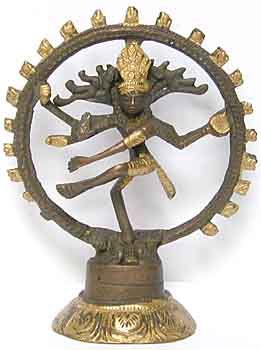
It is not as if this mad lord of ours appears only at certain moments; in creation, his madness is always at work; we only get a glimpse of it in certain moments. Death is forever making life new, bad is brightening good, and the inconceivable is giving value to the trifle. At the moment we get such a glimpse, the freedom within the form becomes evident to us.
Today, amid this cloudless light, I see that amazing face. That road across, that thatched-roof provisions store, that broken house, that narrow by-lane, those trees and vegetation—I used to see all these with the pettiness of everyday familiarity. That’s why these had confined me—had kept me in house arrest within these daily images. Today, all of a sudden, all the pettiness is gone. On this day I see that for so long I had been viewing the unknown as familiar; my seeing wasn’t clear at all. Today, I can’t finish looking at all these. Today, all of these things surround me, yet they don’t imprison me, they all make way for me. My madman was here only—that spectacular, unknown wonder, who did not ignore this thatched-roof provisions store—only, I didn’t have the light before my eyes with which to view him. What is amazing about today is that these nearby images have acquired for me the glory of a far-off place. The impenetrability of the snow-capped Himalayas and the impassability of the wave-ridden ocean express their fraternity with the madman.
In this way, one day we suddenly realise that the one with whom we had established a familial relationship remains outside our family. The one whom we had taken to be readily available in every moment is actually rare and hard to get. Those, around whom we had drawn a boundary thinking we knew them well, appear to have acquired a marvellous mystery by crossing all boundaries. The same one who, when viewed from the side of rules and balance, appeared rather small, quite regular, very familiar, when viewed from the side of breach, from the angle of that graveyard-roaming madman, turns me speechless—amazing! Who is that! The one whom I have always known is now this, who! The one who is part of the home on one side belongs to the heart on the other. The one who is important to work on the one hand is completely outside all necessities on the other. The same one whom I touch on the one hand is, on the other, beyond all grasp. The one who has managed to fit well with everyone is, at the same time, a total misfit, absorbed in self.
Today I saw the one whom I don’t see every day. In so doing, I gained freedom from every day. I thought I was bound by the everyday rules within the fence of familiarity surrounding me. Today I see, I have been forever playing on the lap of grand wonder. I thought that I had been making my daily calculations under the sharp gaze of a big officer in the office. Today, at the roaring laughter of the miscalculating madman—who is bigger than the big officer—reverberating through water, land, sky, air and the entire universe, I heave a sigh of relief. My workbook remains untouched. I lay down the pile of my important work at the feet of that capricious madman—let the blow of his Tandava (9) smash it into pieces and blow it off as dust.
1. Ashadh: A month of the Hindu calendar
2. Nimai: A prominent saint of medieval Bengal and the founder of Bengal Vaishnavism. Also known as Chaitanya Mahaprabhu.
3. Maheshwar: Another name for Shiva, a major Hindu deity. The god of destruction.
4. Bholanath: Alternative name for Shiva.
5. Nandi: Shiva's vehicle, a bull.
6. Bhringi: Originally a demon who was transformed by Shiva into a humble devotee and admitted into his force as a commander of his armies.
7. Pinak: Shiva's bow.
8. Yagna: A Hindu ritual, dating back to Vedic times, carried out to please gods. Oblations are poured into sacrificial fire, as everything that is offered into the fire is believed to reach the gods.
9. Tandava: In Hindu mythology, Shiva’s Tandava is a vigorous dance that is the source of the cycle of creation, preservation and dissolution.
16 Dec 2008
Peep Peep Don't Sleep: Book Review
 Peep Peep Don't Sleep
By: Ajay Jain
Kunzum
Non-fic (Travel)
Price: INR 350, US $19.95, UK £11.95
Available at: Ajay Jain's Blog
We thought travel was about visiting places, soaking up the atmosphere of new territories, and relishing the journey. Who could have known Road Signs could be part of the travel entertainment package as well? Yes, Road Signs, those inevitable pointers along the way that we take no more seriously than empty coke cans strewn across the terrains we travel through.
Welcome then, to the world of Border Roads Organisation (BRO), the Indian agency responsible for construction and maintenance of all roads in areas along India’s borders with Pakistan, China, Nepal, and Bhutan. For, BRO, with its BROtherly (even fatherly at times) attitude, can turn the toughest of driving trips along India’s edges into the funniest. Many a traveler journeying through these often rugged stretches must have enjoyed a smirk or four reading BRO’s imaginative Road Signs. Author-journalist Ajay Jain has, however, done a favour to those of us who are yet to grab the fun for ourselves. With his book, Peep Peep, Don’t Sleep.
Jain drove more than 10,000 kilometers, all by himself, through Indian highways for more than a year to photograph some of the most hilarious, and at times, indecipherable Road Signs and advertisements. He didn’t stop there, though, but went on to add witty captions to these images, along with some chuckle-provoking commentary.
Ready for some sampling?
“I am curvaceous, be slow.” Relax, this is no porn movie dialogue; it’s just a hilly road in Ladakh, nudging you, the driver, to go easy with the wheels. And if you still don’t get the message, you are again poked to just “Feel the curves (do) not test them.”
The extent to which BRO can go to encourage drivers to play it safe is amazing. On a road from Dehradun to Mussoorie, a sign speaks thus for a distressed husband:

But BRO can’t place such a sign in just one place. And so they warn female partners again at another spot to not gossip as their male companions control the steering.

Jain’s caption to that image can’t stop wondering though, “…Do only ladies gossip?” My question too.
Then there are the cryptic signs. Ones that instead of making you more cautious with your feet on the accelerator will likely leave you scratching your head. Like the following sign. If you can decipher it, kindly do the author and me a favour by letting us know what it means.

And while you are at it, please crack this one too:

By now, you can make out how earnest BRO is in its aim to keep a check on travelers, especially drivers. If one still fails to heed their message, though, one must be prepared to face embarrassment at some point. With a message that says, “Cution. Short cuts may cut shorts.” With such a warning, one can never take any chances, can one? And if the driver still doesn’t listen to the BRO, well, he or she might have to contend with the deadliest of outcomes:

Ajay Jain didn’t just compile funny, inane, and quirky Road Signs in these 200-odd pages. He also went on to put together some of the most bizarre advertisements found across India. A lot of these he found in Dharamsala, the sanctuary of the Dalai Lama and a large number of his followers. His commentary on this section of the book says it all, “Welcome to the Dharamsala School of Quick Learning… You can find enlightenment and knowledge being sold—fast food style—all over Dharamsala…"

Did you know shopping discounts led to tension? So if you are in Dharamsala, spare yourself needless anxiety by shopping at:

In case you thought all shops selling similar stuff are the same, think again. Or rather, know for yourself by visiting this store in Ladakh:

In the short space of a review, it’s hardly possible to capture the amount of fun “Peep Peep Don’t Sleep” (one of the Road Signs in the book, by the way) packs. As I laughed, smirked and found myself bewildered through Peep Peep’s pages, I also realized this excellently produced book is a keeper. Not only is it a testament to what can happen when the English language is twisted albeit inadvertently, it’s also a manifesto of the BRO’s sincere, if a bit over-the-top aim of cautioning the (sometimes) sleepy, reckless, or drunken driver.
All photos © Ajay Jain
Cross posted at: A Reader's Words
21 Sept 2008
Echoing Rendezvous
I came to see you. Yes, there was work, but does one need work to come and see you? As I told fellow train passengers the reason of my meeting with you, I smiled inwardly at the flimsiness of it all. Aren't you both the context and pretext for every visit of mine?

Upon reaching, I looked for a familiar face among the milling, hollering mass of heads floating before the eyes. I searched for Anwar, the rickshaw-puller, who hadn't only acquainted me with you, but had also helped me know you so intimately. I couldn't find Anwar, but you hadn't forgotten me.


And then, when it rained even as evening's dark cloak couldn't soak all that outpour, there, at the craft shop, miles and miles away from where we were staying, you sat with me and nudged me to enjoy the rain with you. For monsoons take on such an electric aura in your company. And I remember the worry in my heart dissolved in that torrent, even as it washed through the meadow, the garden, and those swaying bamboo poles.

On the day of my farewell, Anwar showed up at the door. Not for a moment during my courtship with you could I predict you had stored this mischief for the day of my departure. As Anwar's yellow teeth gleamed through his unkempt mustache, I could see you winking once more. As I stepped on to his rickshaw, you stood by at every stop of mine—the baul neighbourhood, the bookstore, the street-side jewelry shops.

Leaving you wasn't easy, but who said I did? Shantiniketan, dearest, you remain alive, green, and invigorating right here, no matter how far I am from you in terms of space. Or time.
18 Sept 2008


31 Dec 2007
End of Year by Rabindranath Tagore
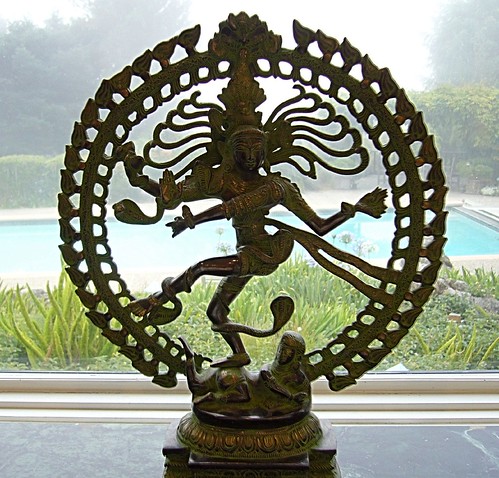
Tired of body and mind, I had thought I wouldn’t get entry into the year’s last day today. Suddenly, thick clouds caressed the woods; the expansive bliss spread across the horizon didn’t appear as emptiness, but as beauty. I see this evening filled to the brim with the wholeness that rests within the endless stream of the world’s work. In meditation I realized, that which I know as the end in the outside world, hides the seeds of new life in this place.

In every moment I see that life’s entire prosody is contained within conclusion. Without pause, rhythm would lose its identity…In mankind’s history, several civilizations have vanished after a period of grandeur. The reason was that those civilizations had lost the pause; they only scattered their enterprise, didn’t care to pick up the same…So the rhythm broke. The first beat came back in the wrong place, and it wasn’t cessation; it was destruction.
It is my good fortune to have come here today. In the city from which I returned, the evening’s face is that of frenzy, not of well-being. There, death’s identity has lost its solemnity. Human habitations make every effort to deny death. That’s the reason one can’t see the truth of death in such places…
May the end show us that face of liberation, which contains wholeness. Calmly I say, “Dear End, within you resides the infinite. I see in your eyes a trace of tear on this last day of the year; separation, dejection, and weary melancholy eclipse dusk’s darkness. Despite that, assimilating and crossing over all those, I hear your voice within and without. Om. The heart’s pain has only lent it beauty—tears haven’t dulled it, but made it gentler. Every evening, death reveals its calm and graceful face across the immense star-draped sky. Embracing it, we lay down—relieved—all the day’s burdens.
At the end of the year, I see that same vast face resting on the untiring, imperishable throne of darkness. I pay my obeisance to it.”
* Taan is a virtuosic technique used in the performance of a vocal raga in Hindustani classical music. It involves the singing of very rapid melodic passages on the syllable "a." It is similar to the technique ahaat, used in Arabic music. [From Answers.com]
Translated by Bhaswati Ghosh
