18 Jan 2011

28 Nov 2010
Apu's Homecoming: Short Story

A short story I wrote years ago has found its home. Apu's Homecoming is up at Asia Writes, one of my favourite sites. Do read it and give your honest (yes, brutal will do) feedback. I would really appreciate it.
10 Nov 2010
An Award and some Revelations
 The lovely and humorous Gargi hononoured me with the Honest Scrap Award sometime back. As the recipient, I must tell you all ten things about myself.
 Disclaimer: The author shall not be deemed responsible for any boredom this post may cause.
1) The first prize I ever won was for a recitation competition. I was in class (grade) I and bagged a consolation prize for reciting a poem by Swami Vivekananda.
2) In class VI when I had to give up one of the two extracurricular activities of dance and music, I let go of dance. Music has stayed with me, ever since.
3) It was in class VI only that any recognition of my writing came about. The perpetrator of this act was an essay I wrote about a trip to Appu Ghar, an amusement park in Delhi. Our English teacher, with whom I am still in touch, wrote "Good" at the end of it.
4) As a Bengali, I am crazy about fish--possibly in any and all forms. Unlike many Bengalis, I am not so crazy about sweets. There, I said it.
5) I wrote my first short story at age 14. It was in Bangla and was lucky enough to meet the approval of my immensely talented (and accomplished) author Grandma.
6) A place I return to (and must keep returning to) again and again is Santiniketan. I wasn't born or raised there, but it's a heart's connection I haven't been able to explain or eliminate.
7) The first trip I ever made outside my hometown was to the historic city of Agra. Fatehpur Sikri enchanted me even more than the world wonder, Taj Mahal.
8) My technologically challenged brain causes me eternal frustration...Sigh.
9) My first foreign trip happened in 2009, courtesy a translation Fellowship I won for my translation of a remarkable book on legendary sculptor-painter, Ramkinkar Baij. I was in the lovely city of Norwich, UK, for two months.
10) I met my husband through this very blog. He is even there on my blogroll. :)
6 Oct 2010
Night Light
With the breeze of a sudden night
Comes the news of your arrival.
As I dive into the sea of slumber
You wake up,
Fusing the conscious with the unconscious.
The night goes silent, draping a blanket of darkness.
You radiate
In your own light, intrinsic glory--
A star.
At dawn, I wake up,
My feet touch the ground
There too, I see you—
In soft, full smile.
Footloose, the night’s star and the earth’s dust
Embrace, sway each other.
I bow down, pick you up,
To give meaning to my worship.
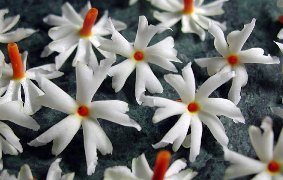
Note: Every autumn, as Durga Puja, the biggest festival of Bengalis, approaches, a certain delicate flower blooms quietly in the night, spreading its soft fragrance all over. Since my childhood, this tropical bloom has awed me with its magical essence. In Bengali, we call the flower Shiuli or Shefali.
Disclaimer: I am not a poet and don't claim this is poetry. It's just a spontaneous expression, triggered by memory.
Comes the news of your arrival.
As I dive into the sea of slumber
You wake up,
Fusing the conscious with the unconscious.
The night goes silent, draping a blanket of darkness.
You radiate
In your own light, intrinsic glory--
A star.
At dawn, I wake up,
My feet touch the ground
There too, I see you—
In soft, full smile.
Footloose, the night’s star and the earth’s dust
Embrace, sway each other.
I bow down, pick you up,
To give meaning to my worship.
Note: Every autumn, as Durga Puja, the biggest festival of Bengalis, approaches, a certain delicate flower blooms quietly in the night, spreading its soft fragrance all over. Since my childhood, this tropical bloom has awed me with its magical essence. In Bengali, we call the flower Shiuli or Shefali.
Disclaimer: I am not a poet and don't claim this is poetry. It's just a spontaneous expression, triggered by memory.
22 Sept 2010
Framed Notes from Beyond
 Postcards from Ladakh
By: Ajay Jain
Kunzum
Non-fic (Travel)
Price: INR 395, US $19.95, UK £11.95
Available at: Ajay Jain's Blog
Among the souvenirs I collect during my travels, picture postcards are recurring visitors. Besides being light in weight--both in terms of mass and price, these cards open mini windows to new worlds. Easy to carry, easy to share, easy to keep or frame--picture postcards have almost everything going for them. Well, almost. My one pet peeve with these cards has been the limited information one usually gets about the picture in question--mostly just a line or two and at the most, about a paragraph. Ajay Jain's new book, Postcards from Ladakh, redresses this issue with commendable facility.
With this book, Jain takes us inside the astonishingly beautiful yet often difficult terrain of Ladakh--among the remotest and most sparsely populated regions of India. Every page you turn is a new postcard--the picture on the left and Jain's notes on the right. As he notes in one of the opening chapters titled Ladakh, Circa 2009, "Start reading from any page," for you won't miss anything if you didn't follow the exact order of the postcards.
The pictures grab the reader's attention right away, and once I had seen/read a few cards, I started imagining my own reading of the images before my eyes floated over to Jain's text. Since this world was as alien to me as that of tribes living in the Congo basin, my imagination couldn't stretch too far. That's where this book succeeded in style. It presented me with just enough information on each accompanying picture without overwhelming me with a flood of it or depriving me by sharing too little. Jain writes the notes in affable first and second person voices, generously interspersing them with wit, practical advice and most of all, his passion for the place.
A big chunk of the postcards reflect Ladakh's Buddhist tradition, its intricacies, distinguishing features and sovereign influence on the local populace. Others highlight the region's flora, fauna, economy, history, and geology. The last few chapters are extremely useful for anyone planning a trip to Ladakh. In these, Jain provides an experienced traveller's tips on how to pack, how to move about and how to keep the environment clean. There's also an engaging interview with Ladakh's spiritual supremo, the Twelfth Gyalwang Drukpa. I found this a nice touch to this collection of postcards.
I leave you now with an invitation to read this book and with some of my favourite postcards:
This image, depicting an old apricot collector, arrested my attention for quite a while. Do you also find the wrinkles on his face speaking of an unknown, unknowable pain?
 Rock art dating to the 6th century AD. On a single rock in the entire region. Intrigued to know more? Visit Ladakh to find out. Or just read Postcards from Ladakh.

Stories like the one this postcard tells warmed my heart the most. It shows a bunch of happy little children who shared their bounty of sweet peas with the author, expecting nothing in return. Although he did reward them with chocolates, I suspect, he was the bigger winner.

This all-religion shrine, situated in the harsh Siachen glacier is believed to bless its devotees, mostly military soldiers, with special "visions."

And lastly, this multi-image postcard about Himalayan marmots is just too good to be denied a mention. The author was lucky himself and shares his most entertaining encounter with these "adorable creatures," who are often a little shy of human presence.

The only additional feature I wished the book included is a glossary of terms. Some of the Ladakhi Buddhist references can get confusing, even with repeated reading. All the same, whether you are in a hurry or at leisure, Postcards from Ladakh is a perfect reading companion. It's also a smart travel guide without posing as one.
Kunzum
Non-fic (Travel)
Price: INR 395, US $19.95, UK £11.95
Available at: Ajay Jain's Blog
Among the souvenirs I collect during my travels, picture postcards are recurring visitors. Besides being light in weight--both in terms of mass and price, these cards open mini windows to new worlds. Easy to carry, easy to share, easy to keep or frame--picture postcards have almost everything going for them. Well, almost. My one pet peeve with these cards has been the limited information one usually gets about the picture in question--mostly just a line or two and at the most, about a paragraph. Ajay Jain's new book, Postcards from Ladakh, redresses this issue with commendable facility.
With this book, Jain takes us inside the astonishingly beautiful yet often difficult terrain of Ladakh--among the remotest and most sparsely populated regions of India. Every page you turn is a new postcard--the picture on the left and Jain's notes on the right. As he notes in one of the opening chapters titled Ladakh, Circa 2009, "Start reading from any page," for you won't miss anything if you didn't follow the exact order of the postcards.
The pictures grab the reader's attention right away, and once I had seen/read a few cards, I started imagining my own reading of the images before my eyes floated over to Jain's text. Since this world was as alien to me as that of tribes living in the Congo basin, my imagination couldn't stretch too far. That's where this book succeeded in style. It presented me with just enough information on each accompanying picture without overwhelming me with a flood of it or depriving me by sharing too little. Jain writes the notes in affable first and second person voices, generously interspersing them with wit, practical advice and most of all, his passion for the place.
A big chunk of the postcards reflect Ladakh's Buddhist tradition, its intricacies, distinguishing features and sovereign influence on the local populace. Others highlight the region's flora, fauna, economy, history, and geology. The last few chapters are extremely useful for anyone planning a trip to Ladakh. In these, Jain provides an experienced traveller's tips on how to pack, how to move about and how to keep the environment clean. There's also an engaging interview with Ladakh's spiritual supremo, the Twelfth Gyalwang Drukpa. I found this a nice touch to this collection of postcards.
I leave you now with an invitation to read this book and with some of my favourite postcards:
This image, depicting an old apricot collector, arrested my attention for quite a while. Do you also find the wrinkles on his face speaking of an unknown, unknowable pain?
 Rock art dating to the 6th century AD. On a single rock in the entire region. Intrigued to know more? Visit Ladakh to find out. Or just read Postcards from Ladakh.
Stories like the one this postcard tells warmed my heart the most. It shows a bunch of happy little children who shared their bounty of sweet peas with the author, expecting nothing in return. Although he did reward them with chocolates, I suspect, he was the bigger winner.

This all-religion shrine, situated in the harsh Siachen glacier is believed to bless its devotees, mostly military soldiers, with special "visions."

And lastly, this multi-image postcard about Himalayan marmots is just too good to be denied a mention. The author was lucky himself and shares his most entertaining encounter with these "adorable creatures," who are often a little shy of human presence.

The only additional feature I wished the book included is a glossary of terms. Some of the Ladakhi Buddhist references can get confusing, even with repeated reading. All the same, whether you are in a hurry or at leisure, Postcards from Ladakh is a perfect reading companion. It's also a smart travel guide without posing as one.
Subscribe to:
Posts (Atom)
